
Secrets and Keychain
Hostwright supports a typed manifest secret-reference model. The manifest stores a reference, never a secret value:
services: api: image: ghcr.io/example/api@sha256:... secretEnv: API_TOKEN: keychain://hostwright.api/api-token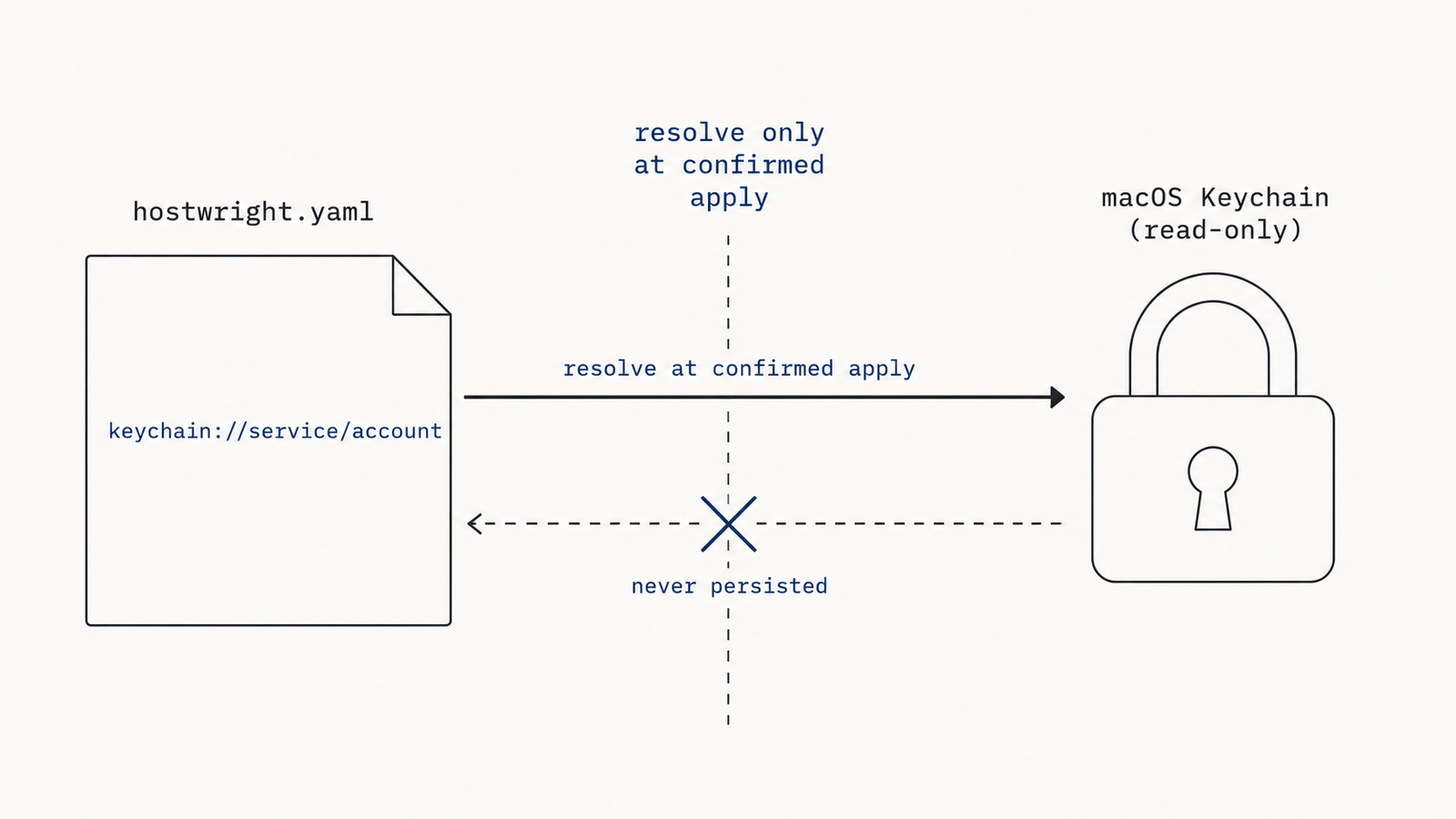
Rules enforced by validation:
- Plaintext sensitive keys under
envfail validation. secretEnvvalues must use one of five typed schemes (below).- The same key cannot appear in both
envandsecretEnv.
Five reference schemes
Section titled “Five reference schemes”secretEnv accepts:
keychain://<service>/<account>: a Hostwright-owned Keychain item, managed withhostwright secret;env-file:///absolute/path#KEY: one key from a guarded local env file;local-file:///absolute/path: the whole contents of a guarded local file;external://<provider>/<item>andplugin://<provider>/<item>: an explicitly registered external or plugin provider.
When references resolve
Section titled “When references resolve”Planning, status, state persistence, diagnostics, events, and errors see only redacted secret-reference metadata. A confirmed lifecycle command resolves references once, immediately before the create step, for the exact project/service/key combination. If the configured backend cannot resolve a reference, the command fails before mutation.
Hostwright also redacts reference labels themselves, because a service or account name can reveal local context, so a reference never appears in plans, state rows, diagnostics bundles, or error messages. Only the resolved value reaches the runtime, and only at the boundary that needs it.
Managing Keychain secrets
Section titled “Managing Keychain secrets”hostwright secret create keychain://hostwright.api/api-tokenhostwright secret update keychain://hostwright.api/api-tokenhostwright secret listhostwright secret check keychain://hostwright.api/api-tokenhostwright secret delete keychain://hostwright.api/api-tokencreate and update read the value from stdin or an attended no-echo
terminal; a secret value is never accepted as a command argument. list and
check return metadata only, never a value. delete verifies exact
ownership and item identity before removal. Every mutation persists a
redacted intent record before touching the Keychain, so an interrupted
operation is inspectable with hostwright recovery and, for an exactly
verified create, reversible through the same command.
The underlying macOS Keychain backend queries an exact service/account pair only, excludes synchronizable (iCloud-synced) items, and disables authentication UI so CLI processes run without a Keychain prompt.
Out of scope
Section titled “Out of scope”Rejected The following are rejected:
- plaintext secret persistence in state, events, or diagnostics;
- Keychain access groups or synchronizable (iCloud-synced) items;
- cloud secret managers or registry credential storage outside the documented
registry loginKeychain item and the fivesecretEnvschemes above; - mounted secret files or multiline/binary secret payloads beyond what
env-file://andlocal-file://already cover; - Compose/Kubernetes
secrets:compatibility.
See State store for the persistence boundary and Security and safety for the wider posture.