
State store
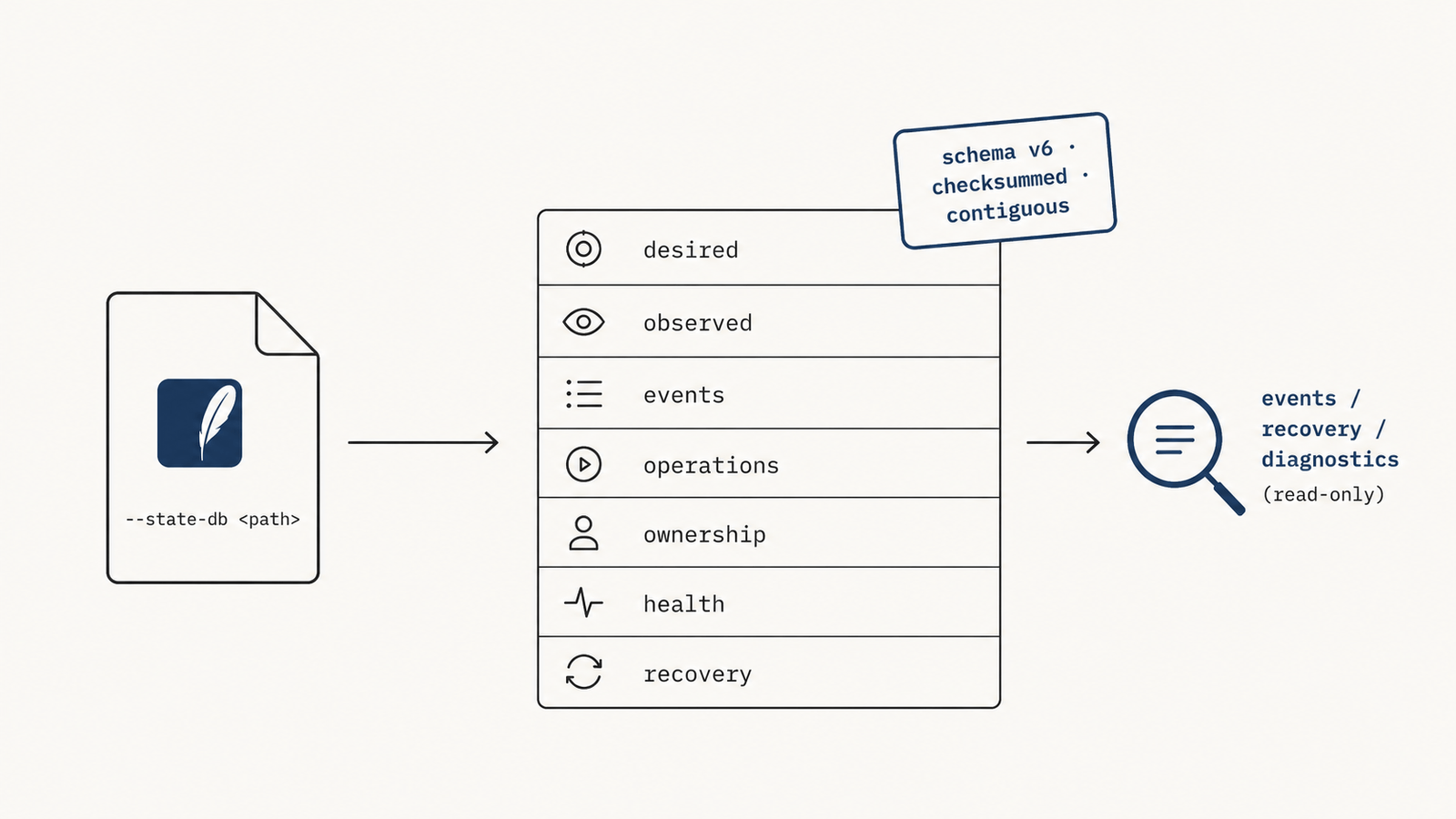
Hostwright’s local state store is SQLite, using the system SQLite3 library
with zero external dependencies. It persists desired-state snapshots, observed
runtime snapshots, the event ledger, operation records, ownership records,
health results, restart policy state, restart recovery records, and operation
recovery groups with step-level checkpoints.
Where state lives
Section titled “Where state lives”State-backed commands resolve their database in a fixed order:
--state-db <absolute-path>on the command line;- the
HOSTWRIGHT_STATE_DBenvironment variable; - the default,
~/Library/Application Support/Hostwright/state/state.sqlite.
# Uses the Application Support defaulthostwright statushostwright events
# Uses an explicit pathhostwright status --state-db /tmp/hostwright.sqlite
State-writing commands create Hostwright-owned directories with mode 0700 and
sensitive files with mode 0600, only when a write actually needs them.
hostwright paths reports the selected path, its origin (explicit,
environment, or application-support-default), the full layout, and
readiness without creating anything. A compatible legacy
~/.hostwright/state.sqlite is moved through an identity-bound, resumable
migration journal; unknown legacy files are preserved.
Write-path commands (status, logs, apply, cleanup, hostwrightd) run
compatible migrations before writing. Read commands (events, recovery,
diagnostics) validate the applied schema and fail rather than creating or
migrating a database as a side effect.
Path safety
Section titled “Path safety”Before opening the database or a lock, Hostwright validates the whole parent
chain: paths must be absolute and normalized, directories must be owned by root
or the current user and never group- or other-writable, user-controlled
symlinks are rejected, and state and lock files must be regular non-symlink
0600 files. State and lock creation use no-follow, exclusive creation, and
file synchronization, and SQLite validates every -journal, -wal, and -shm
sidecar across the open boundary.
Migration continuity
Section titled “Migration continuity”Migrations are explicit and checksummed. The current schema is version 15.
- A database migrated by a newer Hostwright release fails closed with an incompatible-schema error. Hostwright does not downgrade or convert.
- Each migration records a checksum in
schema_migrations. A known version with an unexpected checksum fails before any read or write. - Applied migration history must be a contiguous prefix starting at version 1. A database recording a later migration while omitting an earlier one fails closed. A valid older contiguous prefix stays eligible for forward migration.
Recent schema versions added exact observed resource identifiers, network metadata, ownership identity versions, Hostwright UUIDs, runtime-provider binding, fencing fields, immutable image digest locks, signed image-trust, SBOM, vulnerability, and provenance evidence, and storage volume/snapshot/ backup/orphan/quota records. See Runtime adapter: identity and ownership.
What is (and is not) stored
Section titled “What is (and is not) stored”Normalized columns hold identifiers, project and service names, timestamps, lifecycle states, operation status, event severity, restart status, recovery checkpoints, lock leases, and hashes. JSON blobs hold ports, networks, mounts, environment snapshots, event and operation payloads, and recovery metadata, all redacted before persistence.
Concurrency
Section titled “Concurrency”The contract is single-writer: one CLI command or daemon may write a state
database at a time. Hostwright uses SQLite full-mutex mode, a bounded busy
timeout, and BEGIN IMMEDIATE transactions. If another process holds a write
lock beyond the timeout, Hostwright reports a locked database instead of waiting
indefinitely. Operation-group acquisition is atomic across concurrent stores,
with exactly one winner. Readers share a state-access fence; writers take an
exclusive writer fence; restore, repair, and recover take the exclusive access
fence.
No transaction performs runtime mutation. Apply and cleanup write intent first, leave the transaction, call the RuntimeAdapter, then record success or failure.
State maintenance
Section titled “State maintenance”The hostwright state commands operate on the database only and never touch
Apple container resources.
state integrityruns read-only structure, foreign-key, migration-ledger, and projection checks and reportshealthy,degraded, orunrecoverable.state backuptakes a verified online backup;state backupslists the catalog. Verified catalogs live under~/Library/Application Support/Hostwright/backups, or beside an explicit database.state restorereplaces the database from a backup after a dry run and an exact confirmation token, making a pre-restore backup and clearing stale projections.state repairrebuilds only the reconstructible projection tables when integrity isdegradedin exactly those tables, after a dry run and token.state recoverfinishes an interrupted restore or repair from its durable journal.
Structural, desired-state, ownership, operation, and audit damage is never auto-repaired; restore from a verified backup instead. See the CLI reference for the exact commands and Events and diagnostics for the read-only inspection surface.